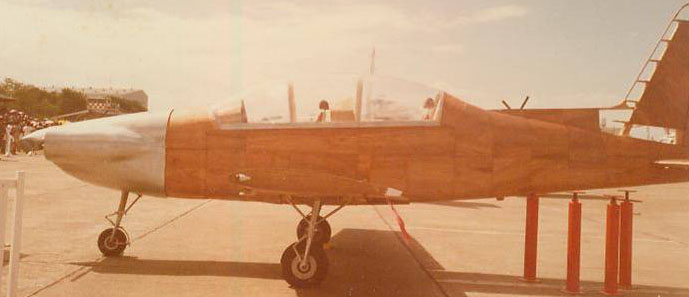
[This is my account of the second successful flight of the Defiant 300, Philippines' first high-powered airplane. This story was published in Aeroscope Magazine, official publication of PATTS College of Aeronautics, in March 1989, of which I was editor-in-chief way back in 1982-1983. Read on.]
by Engr. Ernesto Ferreras Jr.
The Flight
 |
| Prepare for the historic flight |
We held our breath as the Defiant prototype taxied to the foot of the runway. How elegant on its red and white color scheme the airplane stood as it was being cleared for take-off. We were in front of the PAFSECOM's domestic headquarters and we had a good view of the scene that would soon unfold before us. This would be the Defiant's second flight. It made its debut last February 22, 1988 over this same spot and everybody who saw the long-awaited event unanimously agreed it was a successful one.
 |
| From paper to plane |
Some original members of the Norlindo Group (Dawinan, Saltivan, Flora, Salvacion, Pedregosa and Magpantay) had witnessed the historic moment (or so it seems to us). The prototype had been undergoing a series of high-speed taxi test for the past months and the recent one was held last Februaury 19, 1988. The tests proved satisfactory; hence, the decision to proceed to the maiden flight. (I was not able to see the first flight; so this story on the second).
 |
| The Captain ready to fly |
We had waited since 8:30 in the morning. The wind was calm, the sky clear and the day balmy, conducive enough for a second smooth flight. We heard this one would be covered by the press people. It seemed Captain Panfilo Villaruel Jr., the daring test pilot and project director with an indomitable spirit and our former boss, was following the master plan we helped conceive before. The first flight was to be for private consumption without any invited guests or VIPs. The second one was to be for the media.
 |
| Defiant inside the hangar |
We converged in front of the PADC Hangar 2 where the prototype was prepared during the various tests and checks it had undergone. Members of the Group who were already mentioned were there together with me. Students from PATS College of Aeronautics and Airlink International Aviation School began to assemble in front of the hangar, forming small scattered groups, adding to the excitement that filled the air.
 |
| Fuselage frame on stand |
The prototype was parked inside a cordoned area just outside the hangar. We stood beside the ropes feasting our eyes on the airplane that the Group most dearly cherished. It was a thing of beauty to behold, so to speak, and a thing of beauty remains forver - it will remain forever inside us. It had been the darling of our lives for three to four years; we sacrificed our families, spent so much of our time and staked our reputation. We had suffered long enough and when we left to seek our future, the prototype was almost ready to fly.
 |
| Early morning check |
We saw Captain Villaruel talking to barong-clad people around him. We were told this would be a demonstration flight for Captain Victorino Palpalatoc, then director of the Bureau of Air Transportation (BAT). Captain Villaruel donned a navy blue flying suit with the Defiant patch "Nothing can stop us" stitched on his upper right breast. That was the uniform Magpantay had designed for us, ours in light gray color.
 |
| Readying out for taxi |
The sky began to form clouds, gray patches dotting its face. The wind became a little gusty and soon we were wondering whether the affair would continue. At about 9:00 a.m., the Captain stepped into the cockpit. Assistants checked the airplane for the last time, took away the chops and signalled everything was okay.
The first try for the engine was a short burst to life and died down. I murmured, "Go on, go on." The second one was a loud roar and we cheered. The roar was like music to us and this was the first time in months we heard the sound of the Avco-Lycoming 300-hp engine. It elicited joyous shouts from the students who huddled against the ropes.
 |
| The Defiant 300 prototype without the paint |
The prototype started to move slowly through the area towards the runway. We scampered across the area, at the back of the Westpac Hangar to get a good view of the aircraft positioning itself on the threshold.
 |
| The airplane taking off |
I counted the seconds as the airplane began to move. It accelerated effortlessly along the runway, as if there was no air against it. As we viewed it sideways, it smoothly gained momentum, following a straight path through the runway, giving no indication of the presence of a gust or turbulence. The Lycoming engine proved powerful for the Defiant, giving the prototype with more than enough power needed for take-off. Seven seconds later, the prototype was off the ground like a feather gently lifted by a light wind. There was no flutter in the wings; no lateral movement of the aircraft was seen.
 |
| The Defiant flying model |
The climb was long and gradual. The Captain might have taken all the precautions, feeling the controls for the second time. It became a little speck silhouetted against the blue sky when it executed a turn to the right. We followed the maneuver, fixing our eyes on the prototype as it slowly disappeared in the azure expanse above the horizon. I borrowed a pait of binoculars from one of the spectators and focused my sight where the speck was last seen.
 |
| The plane standing majestic |
I saw the aircraft with its landing gears still on, perhaps for precautionary purposes. The prototype seemed to have a smooth straight and level flight as viewed from the ground. I presumed the engine was delivering power just enough for a demonstration flight as the aircraft flew over Manila Bay. The speed was uniform and if there was any acceleration it was so slow to be detected. It took about ten minutes before the aircraft turned for the approach. I remembered fairly well the test flight we had of the Defiant remote-controlled flying model in July 1985 in Fairview, Quezon City. As the model came in for the approach, the scene - both the model and the approach speed - were so realistic to be true. It was as if an actual aircraft was descending to land.
 |
| The prototype preparing to land |
Now before us the scene repeated itself. The approaching prototype was like the balsa model we beheld almost three years ago. There was tension mixed with excitement, the same emotion we felt our hearts were filled to the brim on that day in 1985. The prototype glided beautifully with a steady rate of descent until it touched the concrete runway in front of us. It executed a perfect three-point landing amidst the jubilant cries of the spectators.
 |
| The bare fuselage |
We could not believe it and before we knew, the flight was over. We found ourselves jumping with joy and congratulating each other for all those years we suffered in frustrations and defeat. But the flight just laid to rest the suspicions hurled against us during those agonizing years. The Defiant vindicated the Group against all opposition. For us the historic moment ended not with a bang, not with a whimper but with a great sigh of relief.
 |
| This is it, guys |
 |
| The Norlindo Group, Obi Mapua and the Defiant Flying Model |
The Norlindo Group comprised the following persons, all graduates of aeronautical engineering, except for the last one.
 |
| The Norlindo Group in uniform |
1. Engr. Edgardo Calalang (FEATI) - Group Leader (System installation - landing gears, flight control system)
2. Engr. Norlindo Dawinan (FEATI) - Assistant Group Leader/OIC - Prototype Airframe Construction & Assembly (Design, construction & installation - wings, ailerons, wing skin, engine cowling, paint scheme)
3. Engr. Richard Saltivan (FEATI) - Group Procurement Officer (Design, fabrication & installation - canopy mechanism, ventilation, instrument panel)
 |
| What are you doing, Richard? |
4. Engr. Ernesto Ferreras Jr. (PATTS) - Group Coordinator/OIC - Flight Performance & Documentation (Preparation, analysis & administration - flight performance, engine mount, manpower & scheduling requirements, status & progress reports)
 |
| Keeping the record right, yours truly |
5. Engr. Allan Flora (FEATI) - Structural Engineer (Design, analysis, fabrication & installation - wings, fuselage, wing flaps, flaps control system)
 |
| The prototype or the flying model? |
6. Engr. Salvador Salvacion (PATTS) - Systems Engineer (Design, fabrication & installation - electrical system, battery, engine mount & firewall)
 |
| The static 1:1 model |
7. Mr. Demetrio Suazo (PATTS) - Systems Engineer (Design, fabducation & installation - fuselage frames & skin, canopy shield, cockpit & seats arrangement)
8. Engr. Adolfo Pedregosa (PATTS) - Systems Engioneer (Design, fabrication & installation - vertical & horizontal stabilizers, elevators, rudder, tail fairing)
 |
| Pong and wing ribs |
9. Engr. Marco Magpantay (PATTS) - Systems Engineer (Design, fabrication & installation - fuel tank & system, hydraulics, pitot static system)
 |
| The bare wing, ribs and spars and stiffeners |
10. Mr. Noel Quitain (PATTS) - Systems Engineer (Design & installation - landing gears)
11. Engr. Elpidio Laurel (PATTS) - Systems Engineer (Design, analysis, fabrication & installation - flight performance, flight control system)
12. Mr. Ralphy Hicaro (FEATI) - Systems Support Engineer (Canopy, instrument panel, fuselage, wing skin)
13. Mr. Efren Marasigan (PATTS) - Systems Support Engineer (Fuselage, cowling, wing skin)
 |
| The skin made of veneer plywood |
14. Engr. Alejandro Barcibe (FEATI) - Systems Support Engineer (Canopy mechanism, instrument panel, cowling, landing gears, empennage, engine mount)
15. Mr. Antonio Monteagudo (PATTS) - Systems Support Engineer (Landing gears & doors, fuselage)
 |
| Towing the plane along the runway |
16. Mr. Eduardo Moncera (PATTS) - Systems Support Engineer (Fuel tanks & system, landing gears & doors)
17. Engr. Danilo Santos (PATTS) - Systems Support Engineer (Engine mount, jacking points)
 |
| In happier times |
18. Mr. Leonardo Sun (PATTS) - Systems Support Engineer (Canopy shield, different systems)
19. Engr. Eleuterio Binayug (PATTS) - Systems Support Engineer (Fuel tanks & system, fuselage & wing access doors)
 |
| Meeting of sponsors and supporters |
20. Mr. Ellenric Ditalla (PATTS) - Systems Support Engineer (Canopy shield, different systems)
21. Mr. Eugenio Lanurias (FEATI) - Systems Support Engineer (Canopy shield, different systems)
 |
| We're in the news, too |
22. Mr. Jury Casingal (PATTS) - Assistant Support Engineer (Engine mount)
 |
| The front view: perfect symmetry |
23. Mr. Roberto Alonzo (PATTS) - Assistant Support Engineer (Engine mount, flight controls)
 |
| The side view: majestic in the light |
24. Mr. Jojo Andal (PATTS) - Assistant Support Engineer (Fuel tanks & system)
25. Mr. John Pedregosa (PATTS) - Assistant Support Engineer (Empennage)
 |
| The back view: a thing of beauty |
26. Mr. Nelson Barroga (FEATI) - Assistant Support Engineer (Center-of-gravity determination, manhour requirements)
27. MSgt. Tomas Carrillo (PAF, Ret.) - OIC - Engine installation & maintenance
-ooo-
But he grew old -
This knight so bold -
And o'er his heart a shadow
Fell as he found
No spot of ground
That looked like Eldorado.
- Edgar Allan Poe
 |
| Capt. Panfilo V. Villaruel Jr.: None had been like him before |


.jpg)